.webp)
Buying rural land should not depend on a bank saying yes. If you have been turned down for a land loan, felt priced out by a large down payment, or run into lenders who simply will not finance vacant acreage, owner financing gives you another path. It lets you buy directly from the seller, skip the traditional mortgage process, and start building toward ownership with terms that fit real budgets.
This guide explains how rural land owner financing works in 2026, how it compares to USDA and bank land loans, what qualification and down payments actually look like, and how to find affordable parcels from a few acres to forty acres and beyond.
Owner financing is a land purchase in which the seller acts as the lender. Instead of borrowing from a bank, you make a down payment to the seller and then pay the balance over time in regular installments until the land is paid off. It is also called seller financing or a land contract.
The arrangement is documented much like a bank loan. A purchase agreement sets the price and terms, a promissory note records your promise to repay, and a security instrument (a land contract or a deed of trust) gives the seller a recorded claim on the property until the balance is paid. Depending on the contract type, the seller may hold legal title until your final payment, or you may take title with the seller holding a lien.
Because there is no bank in the middle, owner financing skips appraisals, strict debt-to-income formulas, and long underwriting queues. Deals a bank would reject, like remote parcels, off-grid land, or property without paved road access, are routinely financed this way.
Buyers choose owner financing because it offers:
New to rural property basics? Start with our guide on what rural land actually is.
The core difference is who lends and how flexible the terms are. A bank or government program applies standardized rules to every applicant. A seller offering owner financing can tailor the deal to the buyer and the parcel, which is why it reaches people traditional lending leaves out.
Here is how the three most common paths compare in 2026:
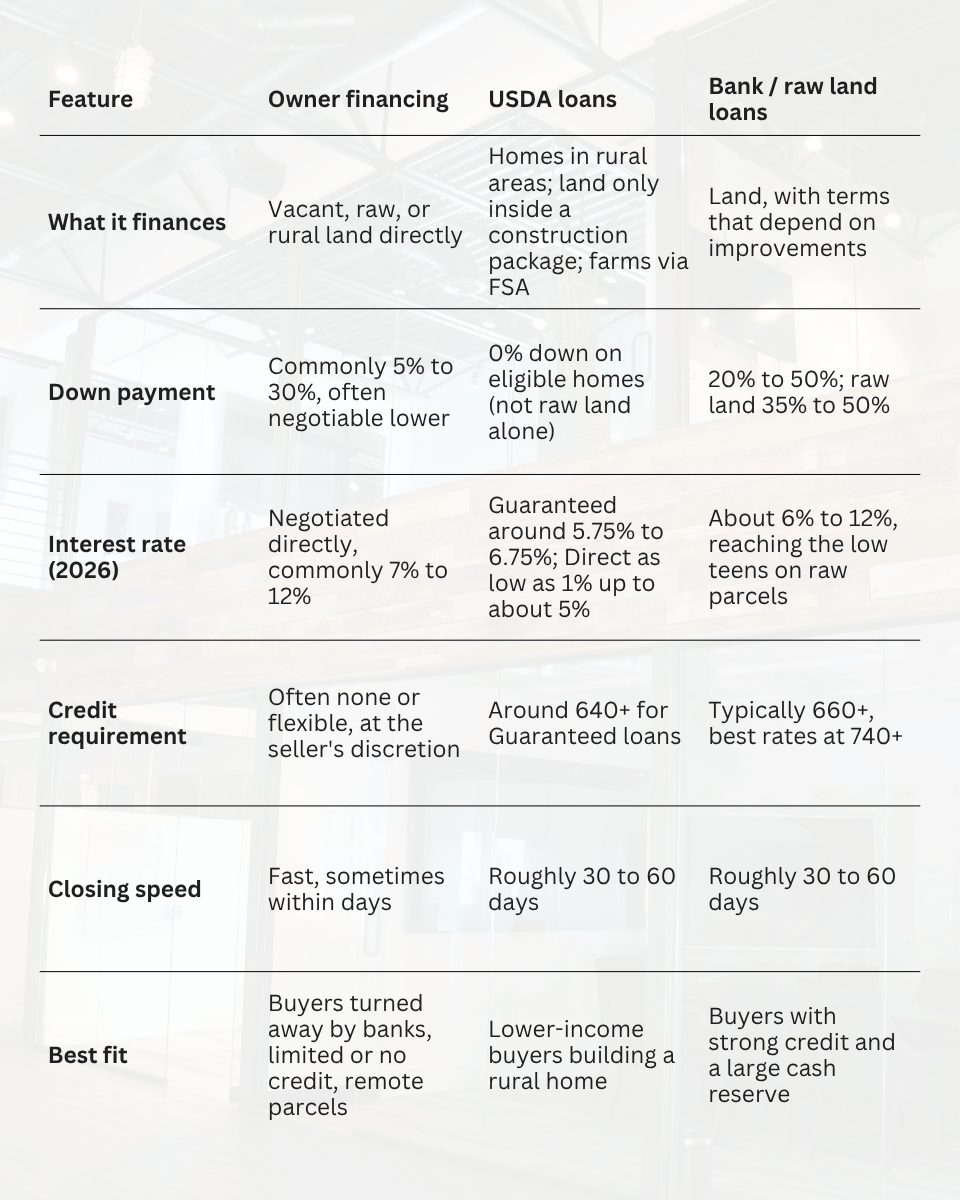
At Mountains West Ranches, the owner financing column above is not theoretical. It is how we sell: a down payment starting at $1,000, tiered interest from 8% to 13.99% based on how much you put down, and a 10 or 15 year term, all with no credit check and no bank. (See the financing disclosures at the end of this post.)
A few points are worth understanding.
Owner financing is the most flexible on qualification and down payment, and it is often the only option for raw or remote parcels that banks will not touch.
USDA loans are frequently misunderstood. The well-known USDA programs, Section 502 Direct and Guaranteed, finance homes in eligible rural areas, not vacant land on its own. You can only use them for land when it is bundled into a construction loan to build a home. For agricultural land, USDA support comes through Farm Service Agency farm ownership loans, which are aimed at working farms and ranches. To compare government-backed routes in detail, see our overview of USDA rural development programs for land financing.
Bank and credit union land loans work well if you have strong credit and a large cash reserve, but they carry the highest down payments and the strictest approval standards. Farm Credit System lenders and local rural banks tend to offer the most competitive of these rates.
Qualifying for owner financing is usually far simpler than qualifying for a bank loan. Many sellers do not run a credit check at all, and approval can come in a day or two rather than after weeks of document review. At Mountains West Ranches, there is no credit check and no bank involved, so approval comes down to a workable down payment and staying current on your payments. Instead of a credit score threshold, sellers generally care that you can make a reasonable down payment and keep up with the agreed payments.
This is the piece that matters most for buyers who have been rejected elsewhere. A past bankruptcy, thin credit history, self-employment income, or a lower score does not automatically disqualify you. The seller is evaluating the whole picture and the parcel, not a single number.
Realistic expectations still apply. Owner financing is a real financial commitment, and defaulting can mean losing the land and the money already paid. Setting an honest budget and understanding how you plan to use the parcel keeps the purchase on solid ground. We walk buyers through practical, realistic land use so there are no surprises after closing.
Traditional land loans, by contrast, typically want a credit score around 660 at minimum, reserve the best rates for scores of 740 and above, and require full income documentation.
Down payment is where owner financing separates itself most clearly from bank lending. Traditional lenders often require 20% to 50% down on rural land, and raw, unimproved parcels sit at the high end of that range, commonly 35% to 50%. That size of upfront cash is exactly what prices many buyers out.
Owner financing lowers that barrier. Seller-financed down payments commonly range from about 5% to 30% of the purchase price, and motivated sellers often accept less. The trade-off is straightforward: a larger down payment usually earns a lower rate and smaller ongoing payments, while a smaller down payment gets you onto the land sooner with a bit more paid over time.
For buyers focused on cheap land or raw land, this flexibility is what makes ownership realistic. A modest starter parcel of a few acres can often be secured with a down payment measured in the hundreds or low thousands rather than tens of thousands. If keeping costs low is the priority, our guide to the cheapest rural land options points you toward the most affordable acreage to pair with owner financing. At Mountains West Ranches, down payments start ass low as $1,000 depending on the parcel, so getting into the land does not require tens of thousands in cash up front.
Typical down payment norms at a glance:
How Mountains West Ranches does owner financing at a glance:
Rates on rural land are higher than home mortgage rates because lenders view vacant land as higher risk. In 2026, bank and credit union land loans generally run from about 6% to 12%, and can reach the low teens for raw parcels with poor access or no utilities. USDA Direct home loans, for eligible buyers building a rural home, can be far lower, as little as 1% with payment assistance up to roughly 5%, while USDA Guaranteed loans sit around 5.75% to 6.75%.
Owner financing rates are negotiated directly with the seller and vary widely, commonly landing in the 7% to 12% range, though flexible sellers may go lower. What you give up in rate compared to a government program, you often gain back in easier qualification, a smaller down payment, and the ability to finance land a bank would decline outright. At Mountains West Ranches, the rate works on a simple tier: the more you put down, the lower your interest, which is why buyers who can add a little to their down payment often save meaningfully over the life of the note.
Terms are equally negotiable in an owner-financed deal. Repayment periods often run 10 to 20 years, and some contracts include a balloon payment due at the end of a shorter window, so it is important to confirm the full payment schedule before signing. Land type also drives cost. Improved parcels with utilities and road access price better than raw, off-grid, or landlocked ground. Our breakdown of what kind of land is cheapest explains how those factors move the numbers.
The figures above are general 2026 market benchmarks. Actual rates and terms vary by seller, lender, parcel, and location.
Owner-financed parcels come in every size, from a starter 5 acres of land for a weekend retreat to a full 40 acres of land for a homestead, working ground, or a private country escape. The right size depends on your plan. Recreation and off-grid living can work on a handful of acres, while grazing, farming, or simply room to spread out calls for larger tracts.
Location shapes both price and possibility. Affordable rural acreage is easiest to find in lower-cost regions, and demand from remote-work buyers, off-grid seekers, and recreational owners has kept rural land in steady demand through 2026. Whether you are drawn to wooded land for sale for privacy and timber, open country land for pasture, a parcel near land and lake for fishing and water access, or wide-open acreage in states like Texas, owner financing makes these options reachable without a bank. To compare affordability across the map, see our state-by-state guide to the cheapest rural land in the U.S.
At Mountains West Ranches, our parcels are located in Utah's Uinta Basin in Duchesne County, open high-desert country with room to build, recreate, or invest, all available with owner financing, no credit check, and no bank required.
Rural land ownership is far more achievable than most people believe. If banks have turned you away, if the down payment always felt out of reach, or if you simply want a straightforward path to owning a piece of country, owner financing is built for exactly that. You make a down payment you can actually afford, pay the seller over time, and skip the credit hurdles that stop most land purchases before they start.
At Mountains West Ranches, we sell owner-financed parcels across Utah's Uinta Basin with no credit check, no bank required, and flexible terms designed for real budgets around the down payment you choose. Browse our current owner-financed listings to find your parcel, and when you are ready to move forward, our step-by-step guide to buying rural land walks you through the entire process.
Your land is waiting. Let us help you get there.
Financing Disclosure:
Owner financing is available on our properties in Duchesne County, Utah. Down payments starting at $1,000 depending on the parcel. Annual percentage rate from 8% to 13.99% determined by down payment amount. Monthly payments over a 10 or 15 year term. No credit check required. Subject to a signed purchase agreement. Terms vary by parcel. Contact us or see the individual listing for details.
What is rural land owner financing and how does it work?
Owner financing is a land sale in which the seller, not a bank, provides the financing. You agree on a price, make a down payment, and pay the remaining balance to the seller in regular installments until the land is paid off. The deal is recorded with a purchase agreement, a promissory note, and either a land contract or a deed of trust, which protects the seller until you complete payment. Because no bank is involved, there are no appraisals or lengthy underwriting, and closings can happen in a matter of days. At Mountains West Ranches, that means buying a parcel in Duchesne County, Utah with a down payment starting at $1,000, no credit check, and no bank, then paying the balance over a 10 or 15 year term.
What are the eligibility requirements for rural land owner financing?
Requirements are far more relaxed than bank lending. Many sellers do not check credit at all and instead look for a reasonable down payment and the ability to keep up with payments. A low credit score, past bankruptcy, self-employment, or limited borrowing history usually does not disqualify you. This makes owner financing a practical route for buyers who have been rejected by traditional lenders for raw or rural land.
How much of a down payment do you need for rural land owner financing?
Owner-financed down payments commonly range from about 5% to 30% of the purchase price, and motivated sellers often accept less. That is well below the 20% to 50% many banks require on rural land, and the 35% to 50% typical for raw parcels. A larger down payment generally earns a lower rate and smaller payments, while a smaller down payment gets you onto the land with less cash upfront. At Mountains West Ranches, down payments start as low as $1,000, tier dependent on the parcel with interest from 8% to 13.99% based on how much you put down.
Can you get owner financing on raw or wooded land with bad credit?
Yes. Owner financing is one of the few reliable ways to buy raw land or wooded land for sale when your credit is poor. Banks routinely decline undeveloped, off-grid, or landlocked parcels, and they set high credit and down payment bars. A seller offering owner financing can approve you based on the down payment and the parcel rather than a credit score, which opens the door for buyers who cannot qualify through a lender.
What rights and restrictions should you review before buying owner-financed rural land?
Before signing, confirm what you are actually buying and what you can do with it. Check zoning and permitted uses, road and legal access, and whether utilities or water rights are available. Review mineral rights, since they are sometimes owned separately from the surface, and look for easements that cross the property. Read the contract closely for the payment schedule, interest rate, any balloon payment, and what happens in the event of a late or missed payment. A title company or real estate attorney can verify the details.